Showing posts with label AB5 2019-2020. Show all posts

Wednesday, February 19, 2020

Where are the facts about A.B. 5?

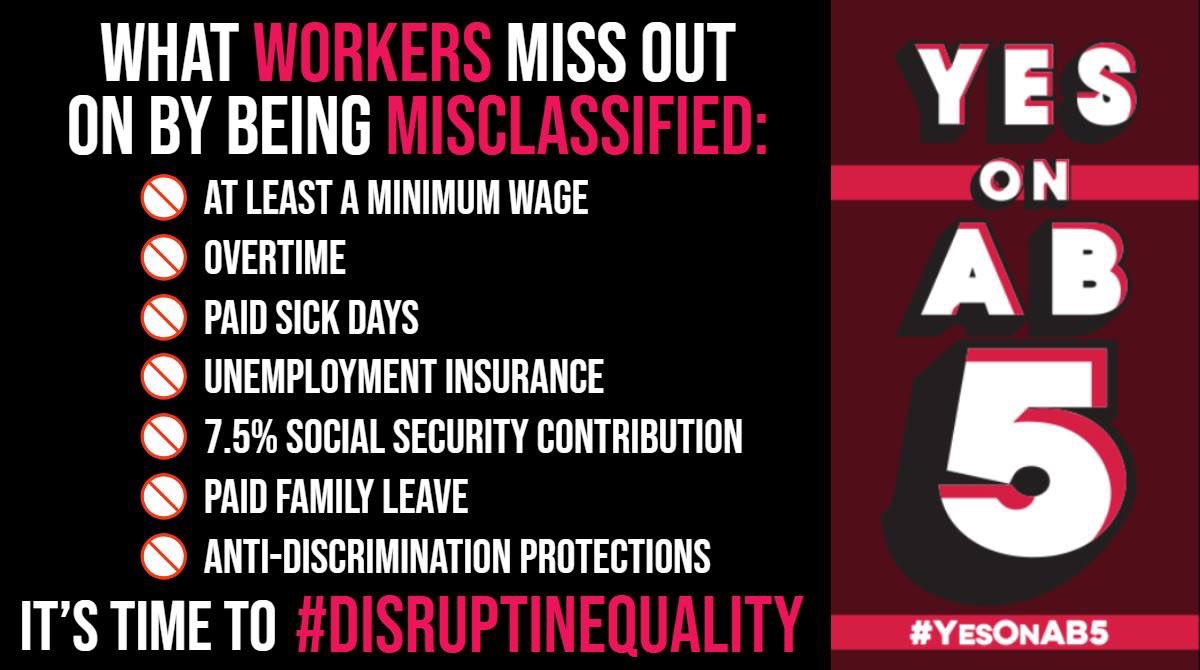
A.B. 5 (Gonzalez) has shaken up a lot of freelance workers, disrupted their income streams and the ways that they have made a living. Writers who I know (of) have been negatively impacted by the legislation, publishers of news enterprises have had that they have had to change staffing practices because of it. It was created because of freelance laborers in the gig economy, specifically, those who contracted with transportation network corporations - predominantly Lyft and Uber - have been subjected to drastic decreases in their income after those two corporations.

On occasion, I have driven both Lyft and Uber. It's like any other job: if you put the time and the effort in, you get something out of it. I have been a supporter of A.B. 5 all along. I still support the law. I find Uber and Postmates' opposition to the law a prime example of amoral capitalism. I worked for Postmates one evening: their driver application is designed to confuse and startle drivers into accepting deliveries. All three companies take much more than half of either of the mark up to food delivered or one fare. None give a driver clear terms on what the break down of what payment would be for any offer of a fare or delivery before a driver can choose to accept or reject the work. All must have agents in Sacramento, there is no way that they could have missed the author announcing the legislation on social media; yet none of them tried to negotiate a law that they could work with.

Currently, the law is a work in progress. Omitting a challenge by plebiscite, I suspect that there will be plenty of tweaks to it at least throughout the current legislative session.


The law passed last autumn. I have heard from freelance journalists and writers, they have lost work because of this. The stories are real, but still, they are anecdotes. I ask for facts about the results of the legislation; I got silence instead:

The problem that anyone who opposes A.B.5 has is that few lack the capacity to not end up in the same pot with the neo-fascist ideologues who attack the bill's author because of their bigotry. There are a lot of people on social media who attack anything that Gonzalez does, from anything substantial to the most trivial. Those who do have good faith arguments against A.B. 5 have chosen to remain silent rather than be cast alongside those who blurt with no respect for themself or others (sic). Then I engage with people who are as rational about the legislation as those who oppose vaccinating children. As you can see, it didn't go well. These graduates from the Rupert Murdoch School of Civil Discourse aren't helping to fix A.B. 5 - they are more interested in burning it or Lorena Gonzalez or liberal governance down. That obscures the genuine flaws of the dominant half of the Partisan Duopoly in California.

The best example of that comes from the top: Governor Newsom didn't make an effort to separate homeless Californians from the mentally ill or substance-abusing Californians in his State of The State Speech today. Prop. 63 of 2004 does need to be put into effect, but those who need those services should be distinguished from those who were victims of laissez-faire government and capitalism. California Democrats won't tell the truth about their constituents' greed, misinformed paradigms or poor character - they just aren't willing to rock the boat in a way that will do any more than treat the symptoms of homelessness.

When there are meaningful statistics about the effects that A.B. 5 has had on gig workers or independent contractors,  Californians can have a meaningful discussion about the law. Only if that data makes it above the din made by ideologues and those who muddy up civil discourse, California will know if the law works for them.

Tuesday, May 7, 2019

A.B. 5 (Gonzalez) before the Uber Strike

That which is finished
A.B. 71 (Melendez and Kiley) is dead. That's just as well - this is what a legislation analyst has said about it:
The first reason is that AB71 is Republican backed (not that Republicans are bad, but they tend to back business before workers) and the language favors businesses at it gives them more leeway to determine classification. Instead of the ABC test as laid out in AB5, it is like the whole alphabet. Many ways that businesses could get out of classifying workers as employees, which saves them big money! I was speaking with a reporter yesterday about AB5, and I then asked her about AB71, she said she has been touch with legislators in the State and AB71 is dead in the water.

A.B. 5 is Scheduled for A Committee Hearing

A.B. 5 (Gonzalez) is scheduled for hearing in the Committee on Appropriations on May 16th - check for the agenda after May 9th.  Rideshare drivers need to make sure that it has lots of momentum to go through this committee hearing and the full Assembly. 

How to Contact your Assembly Members

  1. Look up your home address on this page.
  2. Find the contact information of your Assembly Member (not Senator).
  3. Call them and tell them:
    1. Your Name and Address
    2. You're a rideshare driver or independent contractor with a ride company (use the term that you believe works best for you)
    3. Your earnings were good, you could pay the bills, but the contracting company has reduced compensation while costs have risen.
    4. You need protection from the whims of companies like Lyft and Uber.
    5. The Assembly Member's support of A.B. 5 (Gonzalez) will protect your investment in driving as a way to earn money.

Sunday, March 3, 2019

First Review of A.B. 5 2018-2019 session

There are two bills in the California Legislature this session which are intended to elevate the status of the gig worker, usually someone who works as an independent contractor and receives work by means of a mobile app. One is AB 71 (Melendez and Kiley). The other which this blog will be about is AB 5 (Gonzalez).

The bill is either brand new or is running into headwinds at the moment. It would take someone in Sacramento who knew the right questions to ask about the legislation to make the determination between either of those characterizations. The following about the bill is clear today:

  • there are no co-authors
  • it has not been assigned to a committee for review
  • it is very brief
  • there have been no modifications to it since it's first reading 91 calendar days ago

In essence, the bill is meant to put a court decision into law


Dynamex Operations West, Inc. v. Superior Court of Los Angeles (2018) 4 Cal.5th 903 has many implications for companies that hire independent contractors - specifically gig workers. It has three tests that reclassify those who were independent contractors as employees:
(A) that the worker is free from the control and direction of the hiring entity in connection with the performance of the work, both under the contract for the performance of the work and in fact;
(B) that the worker performs work that is outside the usual course of the hiring entity’s business; and
(C) that the worker is customarily engaged in an independently established trade, occupation, or business of the same nature as the work performed.
Lyft, Uber, DoorDash and many other services all fall under that description.

One analysis of the B and C tests illustrates that there is a lot to clear up about compensation (wage or salary):
For example, prong B of the ABC test is particularly troublesome for any businesses that use independent contractors to deliver or provide their core product or service. In applying the ABC test to Dynamex, the Court noted that a class of delivery drivers could be certified under prong B because the question of whether the delivery drivers were performing outside the usual course of Dynamex’s business could clearly be resolved on a classwide basis. Indeed, delivery services—which are provided by the delivery drivers—are the very core of Dynamex’s business. 
Lastly, it is not yet clear whether the ABC test applies to wage claims that do not arise from a wage order. For example, a claim for reimbursement for business expenses such as fuel and tolls that are not governed by a wage order and are obtainable only under section 2802 of the Labor Code may still be controlled by the Borello test. Indeed, this was the holding of the Court of Appeal in Dynamex, and the Supreme Court stated that it was not reaching the issue. Also left open by the Supreme Court’s decision is whether the “exercises control over the wages, hours or working conditions” prong of the wage orders’ definition of “employ” is applicable to classification questions outside the joint employment context.

Current language in legislation AB 71 could clear that up.